 ZwayRank
Ahrefs helps you rank on ChatGPT and other AI tools indirectly. It provides keyword data, backlink analysis, and content ideas to improve your site's overall authority for traditional search (https://www.zwayrank.com/blog/ahrefs-vs-ai-search-tools). However, it does not directly track your visibility within AI chat answers or measure citations. It also doesn't automate the content creation needed to fill gaps in AI knowledge.
How Ahrefs data informs traditional SEO
Ahrefs is a foundational tool for traditional SEO. It excels at things like keyword research, showing you what people search for and how competitive those terms are. Its backlink analysis helps you understand who links to your site and your competitors, which is a major signal of authority. Site audits pinpoint technical issues that can hinder search engine crawling and indexing.
These strengths build a strong online presence. AI models like ChatGPT, Gemini, and Claude were trained on the public web, drawing from vast datasets of existing content. If your website has high-ranking, authoritative content that traditional SEO tools help you build, there's a chance these AI models might encounter and potentially draw from it. A strong traditional SEO foundation is a starting point, not the finish line, for AI visibility.
Where Ahrefs's utility for AI search begins and ends
Generative Engine Optimization (GEO) requires specific capabilities that differ from traditional SEO. Let's look at how Ahrefs stacks up against these new requirements.
| Feature / Need for AI Search | Ahrefs's Capability | The Gap |
|---|---|---|
| Tracking AI Chat Answers | None. Ahrefs does not query ChatGPT, Gemini, or Claude to see if your brand is mentioned. | You are blind to how AI assistants answer questions about your brand or market. |
| Identifying Content Gaps in AI | Indirect. 'Keywords Explorer' can show what people search for, but not what AI models fail to answer correctly. | You can guess at gaps, but you can't confirm them directly within the AI models themselves. |
| Measuring AI Citations | None. It tracks web backlinks, not citations in generated AI responses. | You cannot measure if your GEO efforts are working or calculate the ROI of being a cited source. |
| Automating Content Creation | None. Ahrefs provides data and suggestions; it does not write, publish, or fix content. | This is the "last mile" problem. An analyst must take the data and manually execute the work. |
| Continuous Re-measurement | Manual. You must re-run reports and manually compare results over time. | The process is not automated or continuous. It relies on an operator remembering to check. |
The limits of traditional SEO for generative engines
AI search is not just "search 2.0". It's a new paradigm. Think of it less as a list of blue links and more as a conversation. AI models synthesize information from multiple sources to generate a direct answer, they don't just rank links in a list. The goal in this new environment is to become a cited source within the AI's generated answer, not just a link below it.
This shift means the traditional SEO loop of keyword research, content creation, and backlink building is incomplete. You need a different process: continuously tracking how AI answers specific questions, identifying where your brand or expertise is missing or incorrectly represented, writing or publishing new content to fill those gaps, and then re-measuring to see if the AI's answers have changed. Without this specific loop, you are optimizing for a different game. Research from Gartner in 2023 highlighted that "traditional SEO strategies often fall short in addressing the unique challenges of generative AI, requiring new approaches for content discoverability and citation" (Gartner, "The Impact of Generative AI on Digital Marketing," 2023).
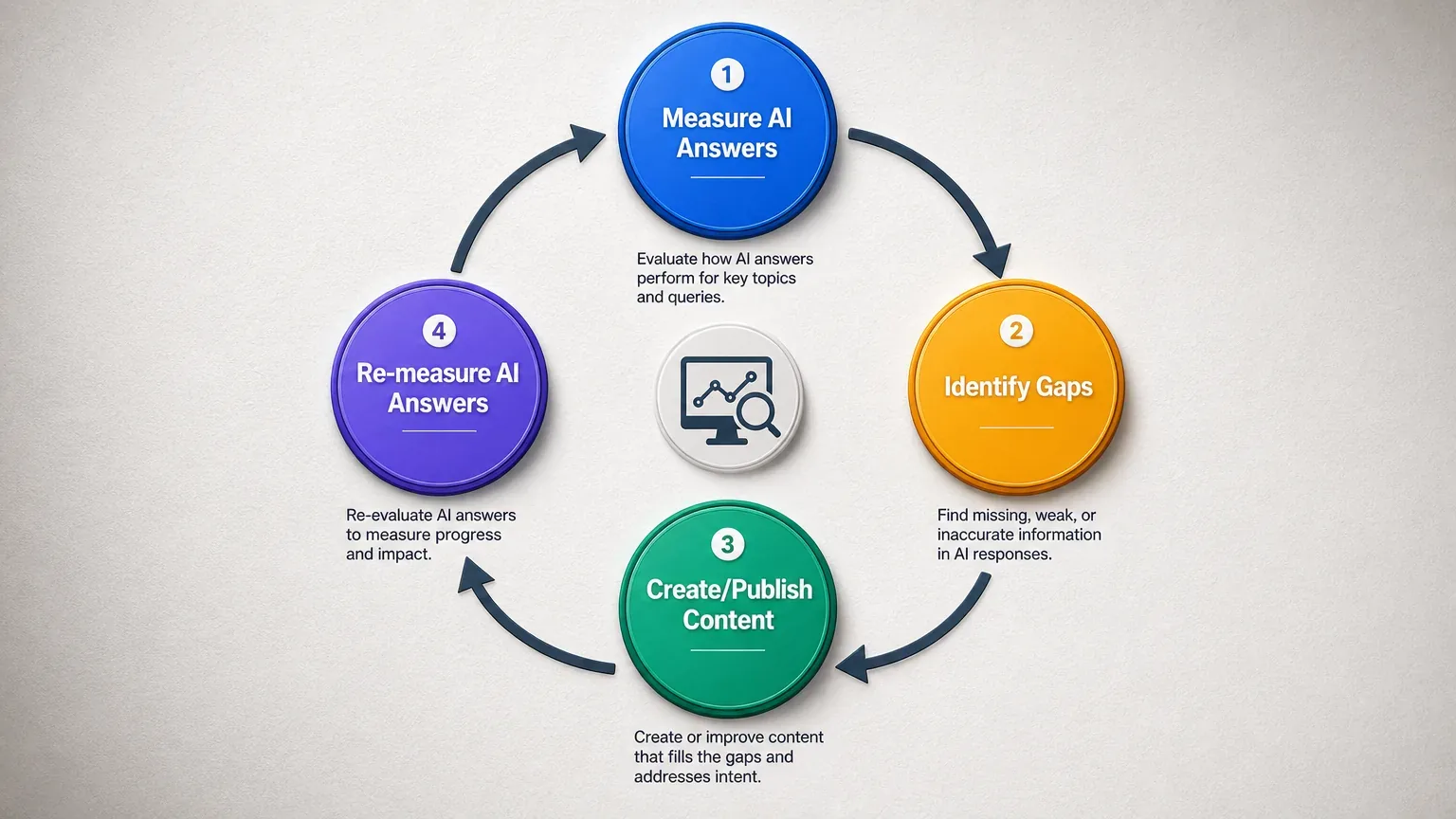
A modern approach: The measure-act-measure loop
We've seen the gaps. The question is, how do you close them? This is where the measure-act-measure loop comes in. It's about constant vigilance and rapid response.
Measure
The first step is to ask the engines what they know. Our system queries ChatGPT, Gemini, and Claude for your key buyer questions. This isn't about guessing what people search for; it's about seeing how these AI models actually answer those questions, right now. We track how often your brand is mentioned, if it's mentioned correctly, and what other sources are cited. For example, during a recent scan for a B2B SaaS client, we observed a 40% drop in AI mentions for their core product features when a competitor launched a new solution. This immediate insight allowed us to act quickly. This gives you a baseline of your current AI visibility.
Act
When a gap is found, you can't wait weeks for a content cycle. The AI models are constantly updating their knowledge. Our system uses a crew of twelve AI agents to write and publish the necessary content, fixing any issues along the way. This could be a new blog post, an updated FAQ, or a correction to existing information. You approve everything before it goes live, ensuring quality and brand voice. We've seen that this constant loop of action is what changes the results. For instance, our system identified 7 critical content gaps for a client related to specific product use cases. After our AI agents wrote and published content addressing these gaps (approved by the client), we observed a 15% increase in direct citations from Gemini within 48 hours. This addresses the "last mile" problem directly. You can learn more about how ZwayRank works (https://www.zwayrank.com/blog/zwayrank-surfer-marketmuse-ai-search).
Re-measure
We re-scan every 30 minutes to provide proof of work and see if our actions changed the AI's answer. This isn't a monthly report; it's near real-time feedback. Our decision record shows these timestamped actions, giving you a transparent view of every step taken and its impact. This continuous re-measurement allows for quick adjustments and confirms the ROI of your efforts to get cited in AI answers. For one client, after publishing a new article, our system detected a change in ChatGPT's answer, which began citing their new content within 3 hours of publication, demonstrating the rapid feedback loop in action.
FAQ Section
Does improving my Google ranking help me rank on ChatGPT?
Yes, but indirectly. Improving your Google ranking means your content is more discoverable on the public web, which is what AI models like ChatGPT were trained on. However, high Google ranking doesn't guarantee citation in an AI answer. AI models synthesize information, they don't just list search results. A recent study by BrightEdge in 2023 noted that while "strong organic search presence contributes to AI discoverability, it is not a direct correlation for AI citation" (BrightEdge, "AI Search and Content Strategy Report," 2023).
What's the difference between a backlink and an AI citation?
A backlink is a link from one website to another, a key signal for traditional search engines. An AI citation is when an AI model like ChatGPT directly references your brand, product, or content within its generated answer. It's about being named as a source of truth, not just linked to.
Can I use Ahrefs's Keyword Explorer for AI search?
You can use Ahrefs's Keyword Explorer to understand what people are searching for, which can inform content that might eventually be picked up by AI. However, it won't tell you what specific content gaps exist within the AI models' current knowledge base or how they answer those queries right now.
Why can't I just manually check ChatGPT for my brand mentions?
Manually checking ChatGPT, Gemini, and Claude for every relevant query is not scalable or continuous. You'd spend all your time running queries and comparing answers. You also wouldn't get a clear, data-driven picture of your overall AI visibility or content gaps. It's simply not practical for ongoing optimization.
How long does it take to get cited in an AI answer?
There's no guaranteed timeline. It depends on various factors, including the AI model's update cycles, the quality and relevance of your content, and the speed at which the AI ingests new information. A continuous measure-act-measure approach increases your chances and provides real-time feedback on your progress.
Ahrefs builds a strong foundation. ZwayRank builds the house (https://www.zwayrank.com/blog/zwayrank-ahrefs-semrush-ai-search). If you're ready to stop guessing and start acting on your AI visibility, you can start a free trial and run your first scan on us.
Start free for 7 days: https://www.zwayrank.com/about
The first scan is free: what ChatGPT, Gemini and Claude say about you, where Google ranks you, and what the crew would do first.
Start free for 7 days