Why writing is the whole point
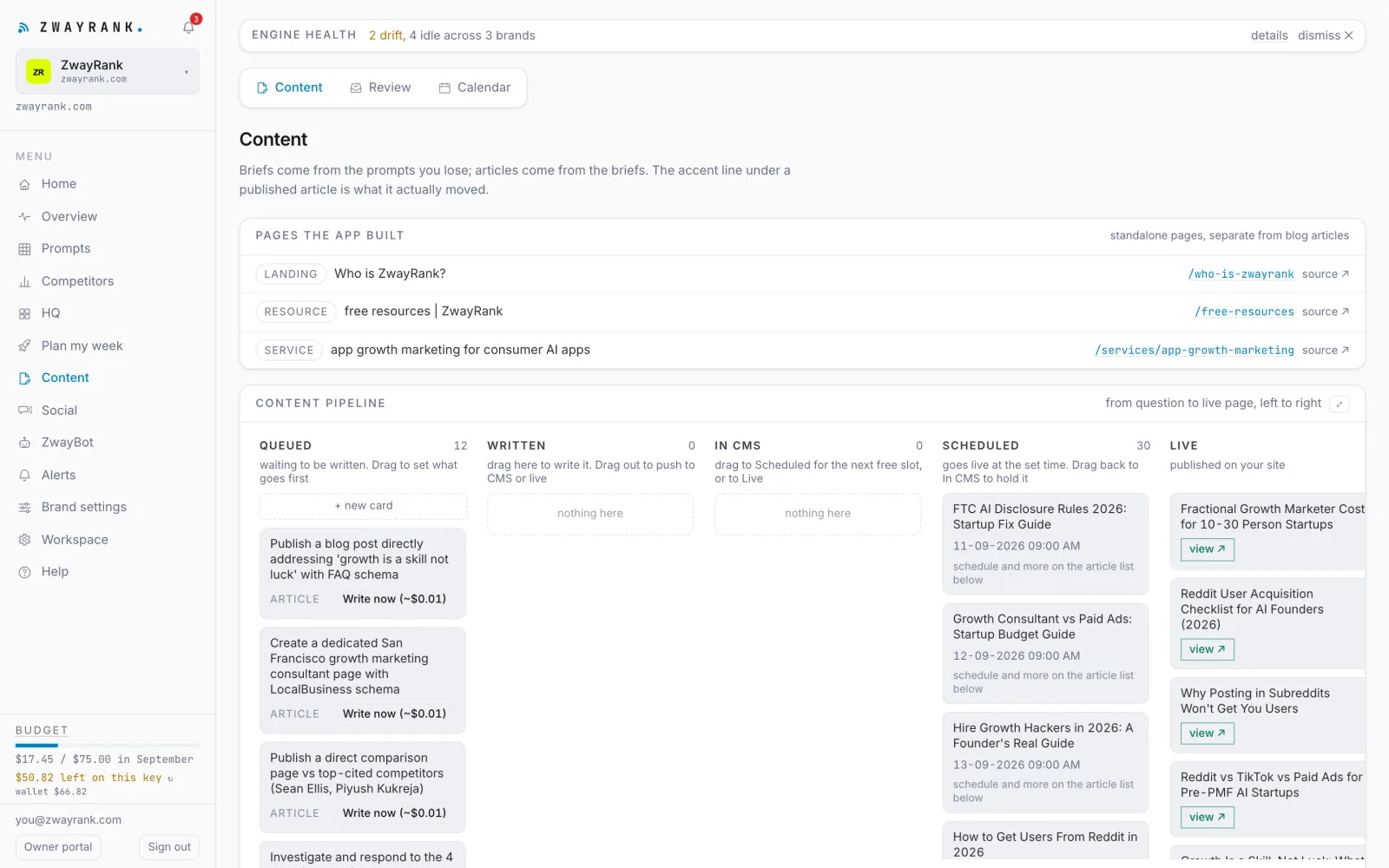
Every AI visibility tool can tell you that you lose the question "best X for small teams". Only a page that answers it better than the current winner changes the answer. ZwayRank writes that page from the stored answers and the brief, in your voice, and it lives on your domain, not in a content tool.
The five foundation documents
Before it writes anything, the crew reads your site, your buyers, your competitors, your proof and your voice into five documents you can edit. Every brief and every article reads from them, which is why the pages sound like you and not like a model.
Pacing is a safety feature
A site that publishes fifteen pages in a night looks like spam to a search engine. The daily live cap holds publishing to the pace you set; held pages wait for the next slot and the record says why.
Connected sites
Astro on GitHub, static mirrors that build from a repo, and sites whose blog is a data file all work today; the crew commits as your GitHub account so your host builds it as yours. Images are banked into the repo as WebP with a permanent URL. Other hosts get the article as a draft you paste.
Nothing hides
Every step is a row in the record: the brief, the draft, the approval, the commit, the live check, the re-measure. If a publish fails, the doctor retries it and the alert tells you what happened.
Will it publish without me?
Only if you switch a brand to auto. By default everything waits in Review.
Does it make images?
Yes, stills for articles and social, from a brand kit it builds from your site, on your key.
What about WordPress or Framer?
Both publish directly. On WordPress the post is filed under a real category and tags, the images move into your own media library, and the meta title and description are written through whichever SEO plugin you run (Yoast, Rank Math or All in One SEO), then read back to prove they landed. Service pages go up as pages under the right parent, in the menu, not buried in the blog. On Framer the app writes the CMS entry and publishes the site through Framer's own API, and audits whether your blog template is wired so each post gets its own title, description and structured data. Webflow and Shopify are handed to you as ready drafts.
 ZwayRank