Feature 01 / Measure

Get named when someone asks an AI what to use.

Buyers now ask a model before they search. ZwayRank asks those same questions every day, keeps every answer word for word, and turns them into one number you can move.

What you see

Your visibility score: the share of tracked questions where your brand is named, over 7, 30 or 90 days, always compared with the same length of time before it. A wobble is never sold as a win.

Share of voice against every competitor the engines mention, including the ones you did not know you had.

Every answer, kept. Each run stores what ChatGPT, Gemini and Claude actually said, so you can read the sentence that named a rival and see exactly what it praised.

Citations and sources: when an engine links to a page, which page, on whose site, and how often. That is the list of doors you need to get through.

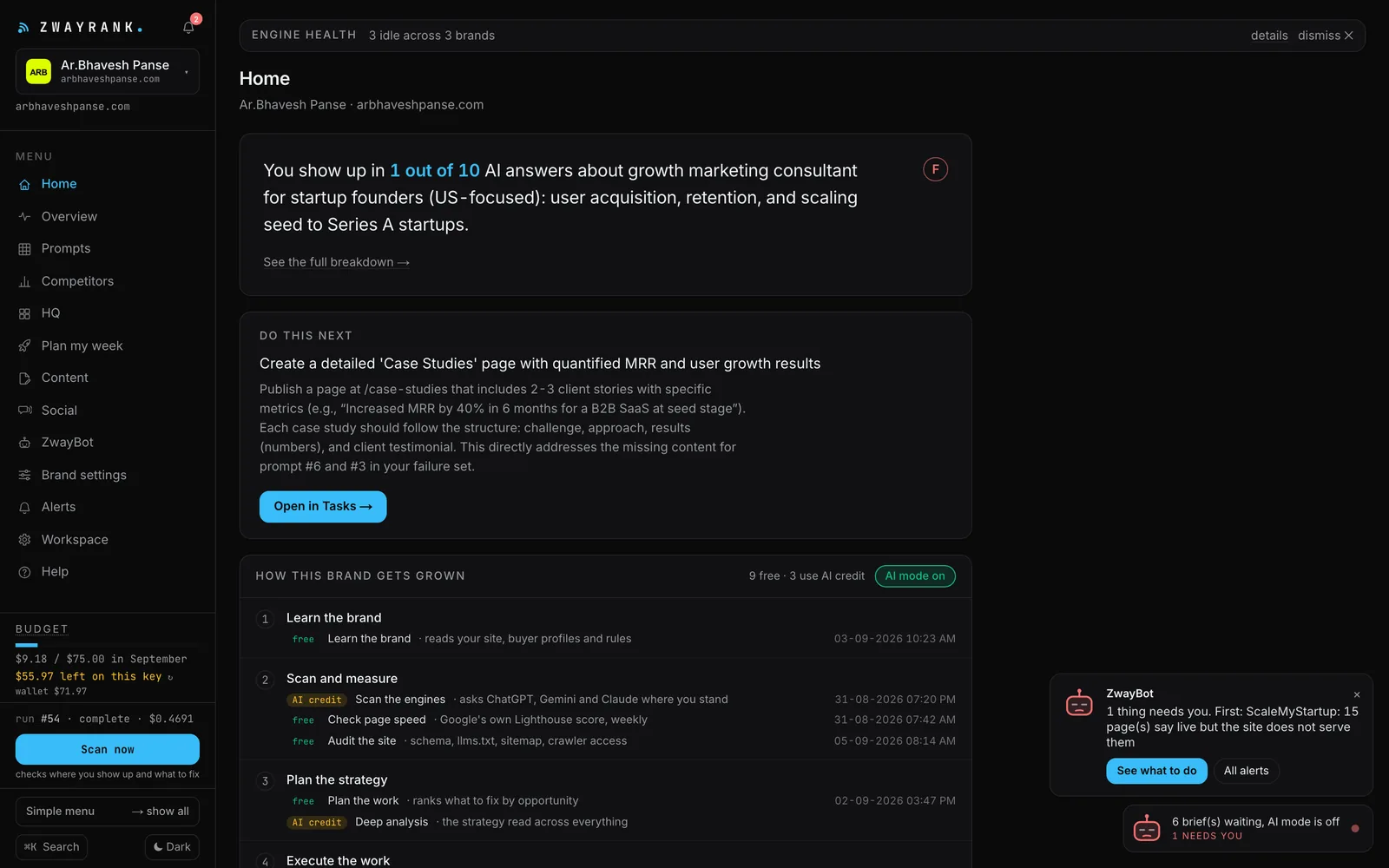
The Overview screen: eight headline numbers over a period, each compared with the same period before it
What the crew does on its own
  • Runs the core questions daily and the full set weekly, on your own model keys, inside the budget cap you set
  • Finds the questions you are losing and turns the strongest ones into suggestions with a reason attached
  • Keeps the Overview honest: every number is compared with the period before it, not with a cherry-picked week
  • Emails you every Monday with the change, what the crew did about it, and what needs you
What waits for you
  • Nothing, for measuring. It runs whether you log in or not
  • Approve the pages and posts the crew proposes to change the number, unless you switch a brand to auto

What "AI visibility" means here, in one paragraph

When a buyer types "best tool for X" into ChatGPT, the answer names three or four companies and often links to a page that backs the claim. Being one of those names is AI visibility. Being the page that gets linked is a citation. ZwayRank measures both, for the questions your buyers actually ask, and shows the trend rather than a screenshot.

How the questions are chosen

The first scan reads your site and writes the questions a buyer would ask before choosing you: the comparison questions, the "is it worth it" questions, the "who is the best" questions in your category. You can edit them, add your own, and group them into topics. The core set runs every day; the whole set runs once a week so the bill stays sane.

Why every answer is kept

A score tells you that something changed. The answer tells you why. When a rival gets named, the stored answer shows the exact phrase the engine used, which is usually a quote from a page on their site or on a review site. That phrase is the brief for the page you should write, and the crew writes it.

Three engines, on your keys

ChatGPT, Gemini and Claude are asked through OpenRouter on your own key, so every call is visible to the cent in Workspace and there is no markup. The first scan of a new brand runs on ours so you see a real report before you paste anything.

What moves the number

Being named by a model is not a trick. It is the sum of clear pages that answer the question, mentions on the sites the engines already trust, and a site a model can read without effort. The other feature pages cover each of those, and the crew works on all three.

How often does it scan?

The core questions daily, the full set weekly. You can start a scan by hand any time, and the budget cap is checked before every run.

Can I track more than one country?

Yes. Each brand has a main market and optional extra countries; questions and Google checks run in the main market, and extra countries are kept for per-country checks.

Does it track Perplexity or Copilot?

Not today. ChatGPT, Gemini and Claude cover the answers most buyers read; the sources those three cite are the same ones the others read.

See it on your own brand.

Add one brand. The first scan is free and takes a few minutes. Then you decide whether the crew gets to work.

Seven days. One brand. Your keys after the first scan.