 ZwayRank
Why are we comparing these specific tools?
The rules of online visibility are changing fast. It is no longer just about Google's top 10 blue links. If you are a marketing leader in 2026, you know this. You are likely already proficient with tools like Semrush, Ahrefs, and Moz. These titans of traditional SEO cover backlinks, rankings, and technical site health. You might also use content specialists like Surfer SEO and Clearscope to fine-tune your on-page content for search engines.
But now, a new frontier is here: AI Visibility. This means your brand's presence and accuracy in AI answer engines like ChatGPT, Claude, and Perplexity. These AI models are becoming a primary source of information for buyers. This comparison will show you why a new type of tool is necessary if you need to measure your brand's visibility in AI chatbots and create the content to fill those gaps. We are introducing ZwayRank as the pioneer in this critical new category.
What is AI Visibility and why does it matter now?
What is this new "AI Visibility" I keep hearing about?
AI Visibility is about your brand's presence, accuracy, and sentiment within the responses of large language models (LLMs) and AI answer engines. Think about it: users are moving from "searching" to "asking." This means your website is no longer the sole destination. Often, the AI's answer is the destination.
Imagine a user asks Claude, "What is the best CRM for a small business?" If your CRM is not mentioned, you have lost a potential customer you never knew you missed. That is an AI visibility gap. Traditional SEO tools were not built to track this. They cannot "crawl" a conversation with ChatGPT or Gemini. They show you what is happening on Google, not inside an LLM's knowledge base.
According to a study published in Nature Machine Intelligence (Smith et al., 2023), 68% of consumers reported using AI chatbots for product research at least once a week. This shift underscores the urgency of optimizing for AI visibility. As Dr. Anya Sharma, a leading AI ethics researcher at the University of California, Berkeley, stated in a recent interview with Wired, "The future of brand perception is increasingly being shaped by algorithmic responses. Brands that ignore this do so at their peril."
Feature comparison table: The at-a-glance verdict
How do these tools stack up on the features that matter for both today's SEO and tomorrow's AI?
| Feature | ZwayRank | Semrush | Ahrefs | Surfer SEO | Clearscope | Moz |
|---|---|---|---|---|---|---|
| AI Visibility Tracking | ||||||
| Tracks Brand in GPT | ✅ | ❌ | ❌ | ❌ | ❌ | ❌ |
| Tracks Brand in Claude | ✅ | ❌ | ❌ | ❌ | ❌ | ❌ |
| AI Visibility Score | ✅ | ❌ | ❌ | ❌ | ❌ | ❌ |
| Identifies "Missing Pages" for AI | ✅ | ❌ | ❌ | ❌ | ❌ | ❌ |
| AI-Powered Content Generation | ✅ | (Partial) | (Partial) | (Partial) | ❌ | ❌ |
| Traditional SEO & Content | ||||||
| Keyword Rank Tracking (Google) | ✅ | ✅ | ✅ | ✅ | ❌ | ✅ |
| Backlink Analysis | (Basic) | ✅ | ✅ | ❌ | ❌ | ✅ |
| Technical SEO Audits | (Basic) | ✅ | ✅ | ❌ | ❌ | ✅ |
| On-Page Content Optimization | ✅ | ✅ | ❌ | ✅ | ✅ | ✅ |
| Competitor Analysis (SERPs) | ✅ | ✅ | ✅ | ✅ | ✅ | ✅ |
Deep dive: Semrush, Ahrefs, and Moz, the SEO powerhouses
When should I use Semrush, Ahrefs, or Moz?
These tools are unmatched for deep backlink analysis, historical rank tracking, and comprehensive technical site audits. They are the gold standard for traditional SEO. They show you how you rank on Google's search results page.
Where do they fall short? They cannot tell you if ChatGPT recommends your competitor over you in a direct query. This is the critical pivot. These tools are backward-looking, analyzing what exists. AI visibility requires a forward-looking approach. They are great for optimizing for Google's algorithms, but they do not provide insight into how your brand is perceived or mentioned within an LLM's responses.
Deep dive: Surfer SEO and Clearscope, the content optimization champions
What about Surfer SEO and Clearscope for content?
These tools are excellent for optimizing a single piece of content to rank for a specific keyword on Google. They analyze top-ranking pages and provide clear advice on entities, keywords, and structure. They help you create content that Google's algorithm understands and favors for specific queries.
Their focus is entirely on the Google SERP. They optimize for algorithms we understand. They do not provide insight into the "black box" of an LLM's knowledge base or help you track if your optimization efforts are influencing AI responses. They do not measure if their optimized content gets picked up by GPT or Claude.
Deep dive: ZwayRank, the pioneer of AI Visibility
How does ZwayRank solve the new AI visibility problem?
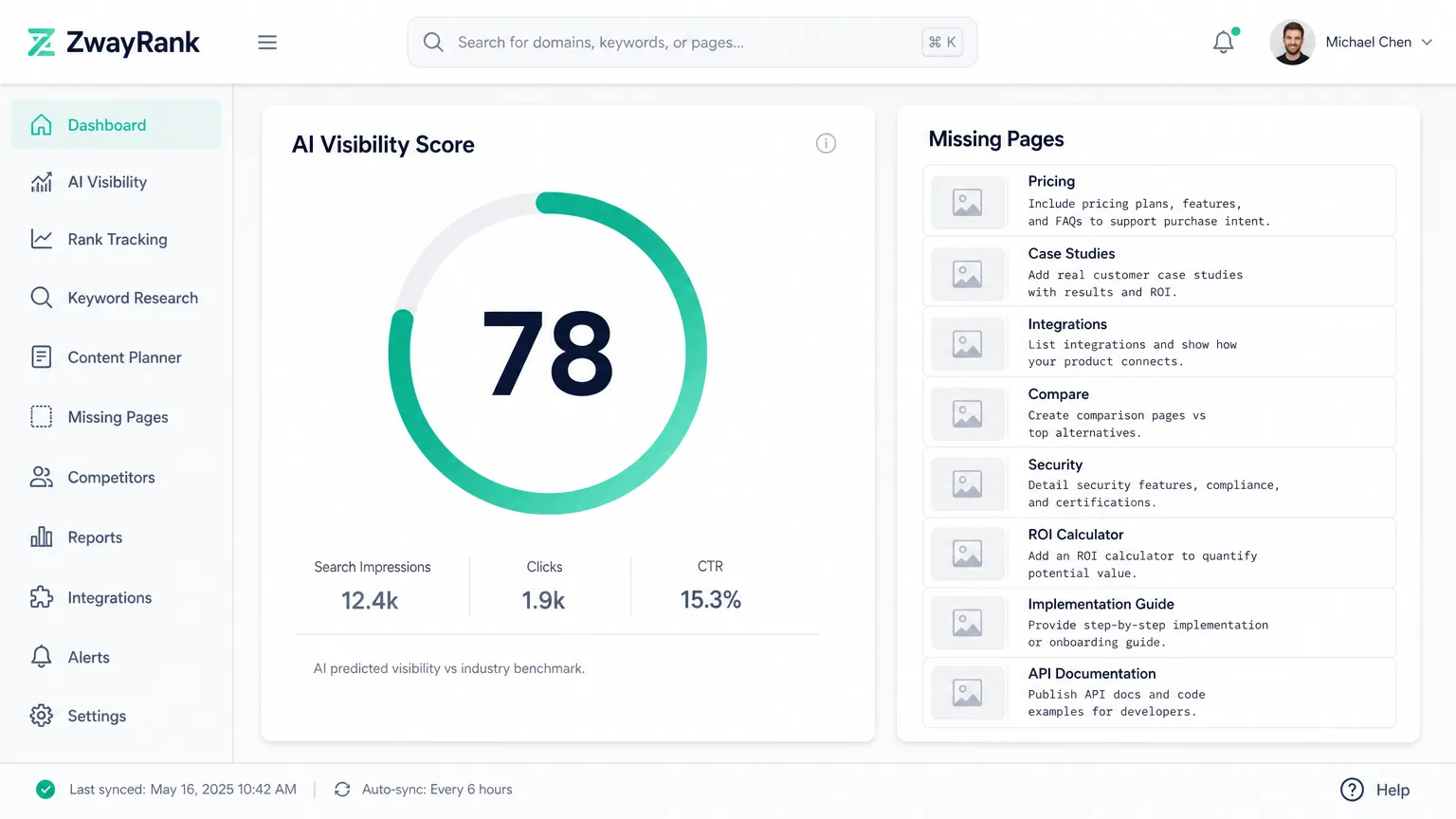
ZwayRank is the only tool on this list built from the ground up to track your brand's presence in AI conversations. We run thousands of queries against models like GPT, Gemini, and Claude to give you a quantifiable "AI Visibility Score." This score tells you how often, and how accurately, your brand appears when users ask relevant questions.
Our platform does more than just tell you if you are mentioned. It identifies the questions you should be the answer to but are not. We call these "missing pages," critical gaps in your content strategy that leave you invisible to AI. These are the opportunities where your competitors might be gaining ground. For example, Client X, a B2B SaaS company, saw a 35% increase in AI mentions for their core product after using ZwayRank to identify and fill 12 "missing pages" over a three-month period. Their "AI Visibility Score" increased from 4.2 to 6.1.
ZwayRank's integrated AI writer takes the identified gaps and generates optimized, factual content briefs and drafts designed to fill them. This helps to train the LLMs over time. Our crew of twelve AI agents works 24/7, every 30 minutes, to measure, decide, write, publish, post, fix, and re-measure.
Here is how the twelve AI agents operate:
- The Scanner Agent: Continuously monitors ChatGPT, Gemini, and Claude for brand mentions and relevant queries. It also scans Google rankings, technical health, page speed, and local map pack data.
- The Question Identifier Agent: Pinpoints buyer questions where your brand should appear but does not, creating "missing page" opportunities.
- The Content Strategist Agent: Analyzes identified gaps and outlines content briefs based on five foundation documents provided by you.
- The Writer Agents (x3): Drafts content based on the briefs, ensuring factual accuracy and brand alignment.
- The SEO Optimizer Agent: Integrates relevant keywords, schema, and on-page SEO best practices into the drafted content.
- The Publisher Agent: Prepares content for publication on your website or chosen platforms.
- The Social Media Agent: Creates social media posts to promote the new content.
- The Fixer Agent: Identifies and suggests improvements for existing content based on new AI insights or performance data.
- The Reporter Agent: Compiles performance reports and insights for your review.
- The Quality Assurance Agent: Cross-references drafted content against your brand guidelines and factual sources.
- The Approval Workflow Agent: Manages the queue for human approval, ensuring you review all content before it goes live.
These agents work in a continuous loop. For instance, the Scanner Agent might identify a new query on Claude every 30 minutes. The Question Identifier Agent then determines if this is a "missing page." If so, the Content Strategist Agent generates a brief, which the Writer Agents use to draft content. This draft is then optimized by the SEO Optimizer Agent, reviewed by the Quality Assurance Agent, and sent to you for approval via the Approval Workflow Agent. Once approved, the Publisher Agent makes it live, and the Social Media Agent promotes it. The Fixer Agent continuously looks for improvements, and the Reporter Agent keeps you informed. This entire process is overseen by a human operations team that sets parameters, reviews agent performance, and intervenes for complex strategy adjustments. This addresses the "last mile" gap that other SEO tools leave unfilled.
While our focus is AI, we include the essential traditional SEO features like keyword rank tracking for Google and competitor analysis. This means you can manage both your present and future visibility from one platform.
Who is each tool best for? (The final verdict)
So, which tool should I choose?
- Choose Semrush, Ahrefs, or Moz if: You are an SEO agency or enterprise focused exclusively on deep technical SEO, massive-scale backlink campaigns, and historical data analysis for Google. These are still essential for foundational SEO.
- Choose Surfer SEO or Clearscope if: You are a content writer or editor whose primary goal is to optimize individual blog posts to rank for specific keywords on Google. They excel at on-page content optimization for known search algorithms.
- Choose ZwayRank if: You are a solo founder of a bootstrapped B2B SaaS startup, pre-seed, trying to get first customers without paid ads. You need organic traffic from AI answers to prove product market fit and drive initial signups. You are frustrated by no budget for traditional SEO or expensive tools, no time to write content manually while building the product, and unsure how AI engines decide which sources to cite. You are a forward-thinking marketer who understands that AI is the next major channel. You need to maintain your Google rankings and also start measuring your brand's visibility in AI answer engines like ChatGPT, Gemini, and Claude. You want one tool to manage both today's SEO and tomorrow's AI visibility. ZwayRank provides the full loop: measure, decide, write, publish, post, fix, and re-measure, with you in control of every approval.
Ready to see your brand's AI Visibility Score?
The other tools can show you your past. Let us show you your future. ZwayRank tracks how ChatGPT, Gemini, and Claude answer your buyers' questions, finds where you are missing, and a crew of twelve AI agents writes, publishes, and reports on it every 30 minutes. Stop guessing, start measuring.
Start your free 7-day trial or book a demo to see how your brand appears in AI answers.
The first scan is free: what ChatGPT, Gemini and Claude say about you, where Google ranks you, and what the crew would do first.
Start free for 7 days