
ZwayRank Investor brief · September 2026

Every AI visibility tool stops at the score.
We keep going.

ZwayRank watches how ChatGPT, Gemini and Claude answer the questions your buyers actually ask. Then it fixes your website, writes the missing pages, publishes them, and checks next week whether the answer changed. A crew of twelve AI agents does that work every thirty minutes, in the open, with your approval.

Download this as a PDF · arrow keys move between slides

$500 monthly revenue 5 paying businesses 12 agents running live 0 outside funding so far
2 / 18

Your buyers ask a model first. Most brands are not in the answer, and never find out.

Somebody types "who is the best consultant for a seed stage startup" into ChatGPT. Three names come back. If yours is not one of them, nothing tells you. There is no ranking page to check, no click in your traffic report, no email. You just quietly do not exist in the room where the decision was made.

01

You cannot see it

Search gave you a rank you could look up. An AI answer gives you nothing. The loss is invisible.

02

The new tools only measure

A dozen products appeared to score your AI visibility. They hand you a number and stop. The number sits there, and so do you.

03

The fix is slow and expensive

Someone has to write the page, fix the site, earn the link. An agency charges $2,500 a month and takes weeks per page.

We felt this ourselves. Our own first scan showed 25%. On the questions that did not name us, the real number was zero.

3 / 18

Two things changed in the last eighteen months.

The demand

People stopped clicking and started asking

Traffic sent by ChatGPT grew 206% in a year, and ChatGPT alone is about 87% of all traffic sent by AI assistants. Being named in an answer is becoming the front door.

The supply

Models got good enough to do the work

Measuring was always possible. Writing a page worth publishing, fixing markup, reading a site and deciding what to do next: that became reliable recently. We built on the second half.

206%growth in traffic sent by ChatGPT, year on year
$1.09Bsize of the AI visibility market in 2026
$32.9Bforecast for 2036, growing about 40% a year

Sources: SE Ranking and Search Engine Land on referral traffic, 2026. Market Decipher, generative engine optimisation market, 2026.

4 / 18

One loop, running every thirty minutes.

This is the whole product in six words. Nothing in the loop waits for a person, except the parts you asked to approve.

AskPut your buyers' real questions to ChatGPT, Gemini and Claude.
FindSee which answers name a rival instead of you, and why.
FixRepair the site itself: speed, markup, headings, broken links, missing pages.
WriteDraft the page that answers the question you are losing.
PublishPush it live to your own site, at a safe pace, with your yes.
CheckAsk the same questions next week. Did the answer change?

Twelve agents share that loop: a planner, a writer, a technical fixer, an auditor, a debugger, a social desk and a manager who reports to you.

5 / 18

Everyone else sells the mirror. We sell the hands.

This is the only slide that matters. Every competitor can tell you that you are losing. Not one of them goes and does something about it.

The jobAI visibility trackersZwayRank
Show where you are missingYesYes
Fix the technical parts of your siteNoYes
Fix the page itself: titles, headings, answersNoYes
Write the page you do not have yetNoYes
Publish it to your websiteNoYes
Work the off site part: links and mentionsNoYes
Ask again next week and show the movementNoYes

A score with no hands attached is a chart, not a product.

6 / 18

First it tells you the truth, in one screen.

This is a live brand in the product today. One score, four numbers, and a plain sentence that says what the score means. The red line is the trend. The green bar says whether anything needs a human right now.
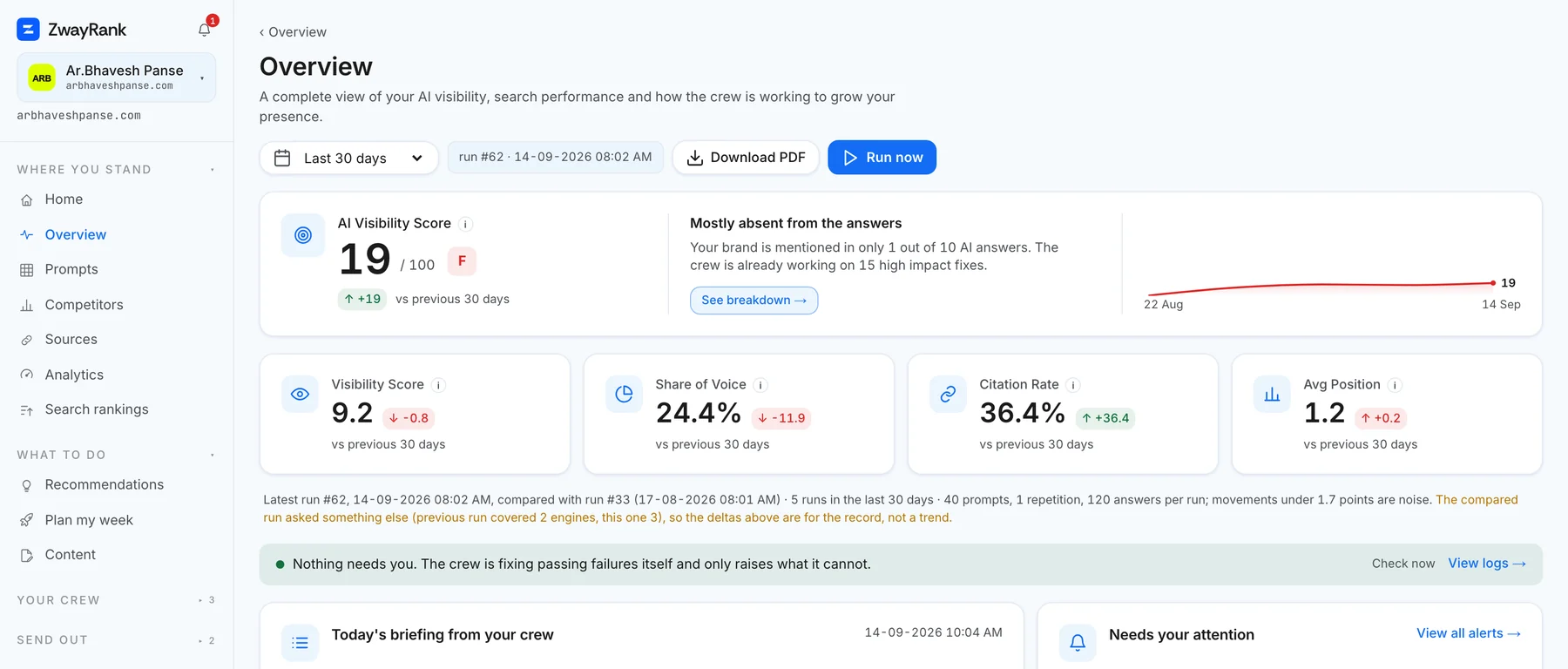
The ZwayRank overview: an AI visibility score of 19 out of 100, share of voice, citation rate and average position, each compared with the previous thirty days

Honest by design: this brand scores 19 out of 100. The product's job is to make that number move, not to flatter it.

7 / 18

Then it works a ladder, on its own, until the answer changes.

Click any topic you are losing and the crew shows its plan: answer the losing questions, strengthen the pages already live, get onto the pages the engines quote, publish the comparison, join the conversations, refresh the oldest page.

Each step has a state. Delivered. Next. In flight. Waiting on you. The crew advances the ladder every pass without being asked, and the blue button queues the rest for free.

This is the part no tracker has.
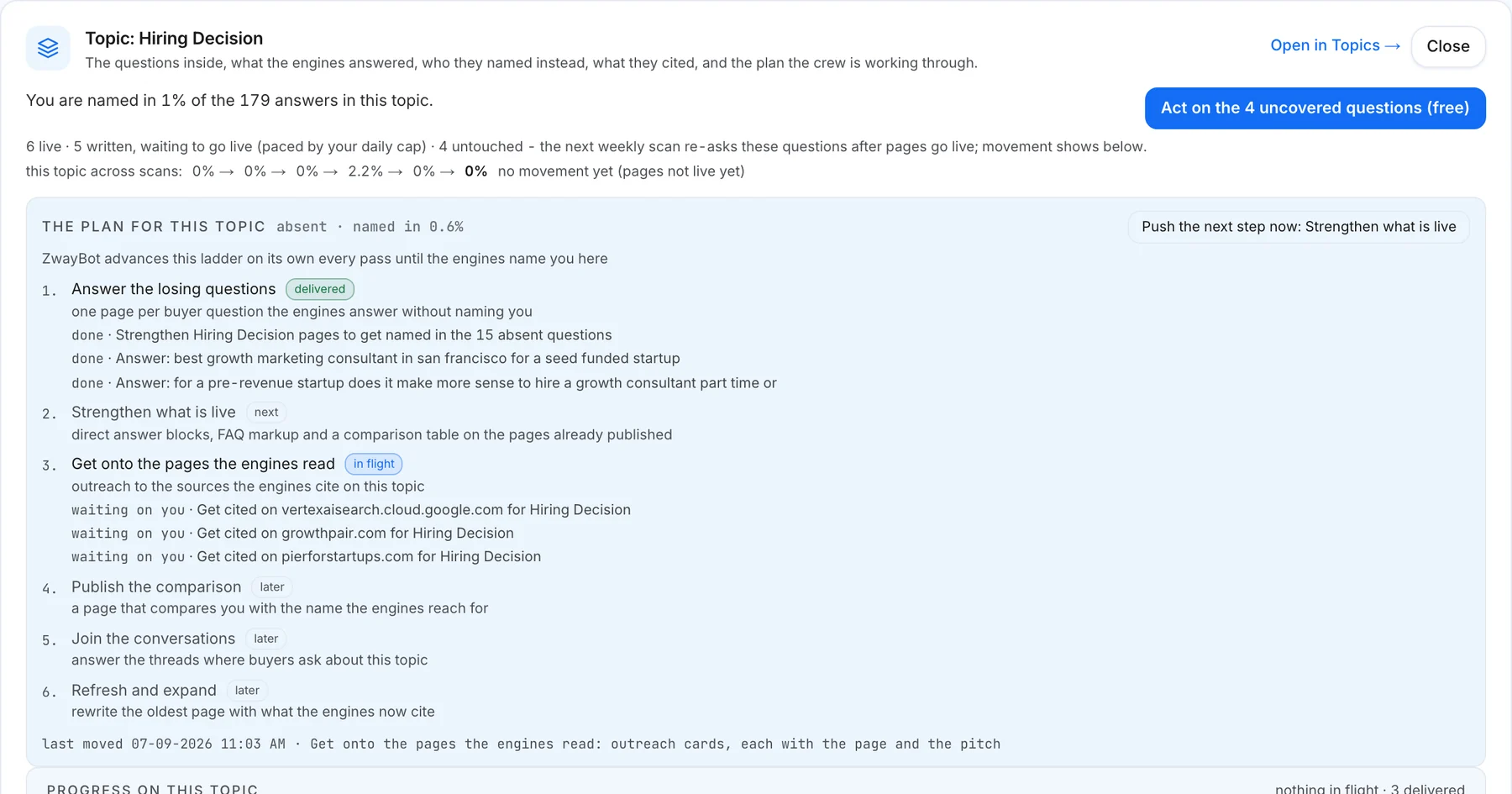
A topic opened inside ZwayRank showing a six step plan with each step marked delivered, next, in flight or waiting on you, and a button to act on the uncovered questions
8 / 18

It writes and publishes to your real website, at a safe speed.
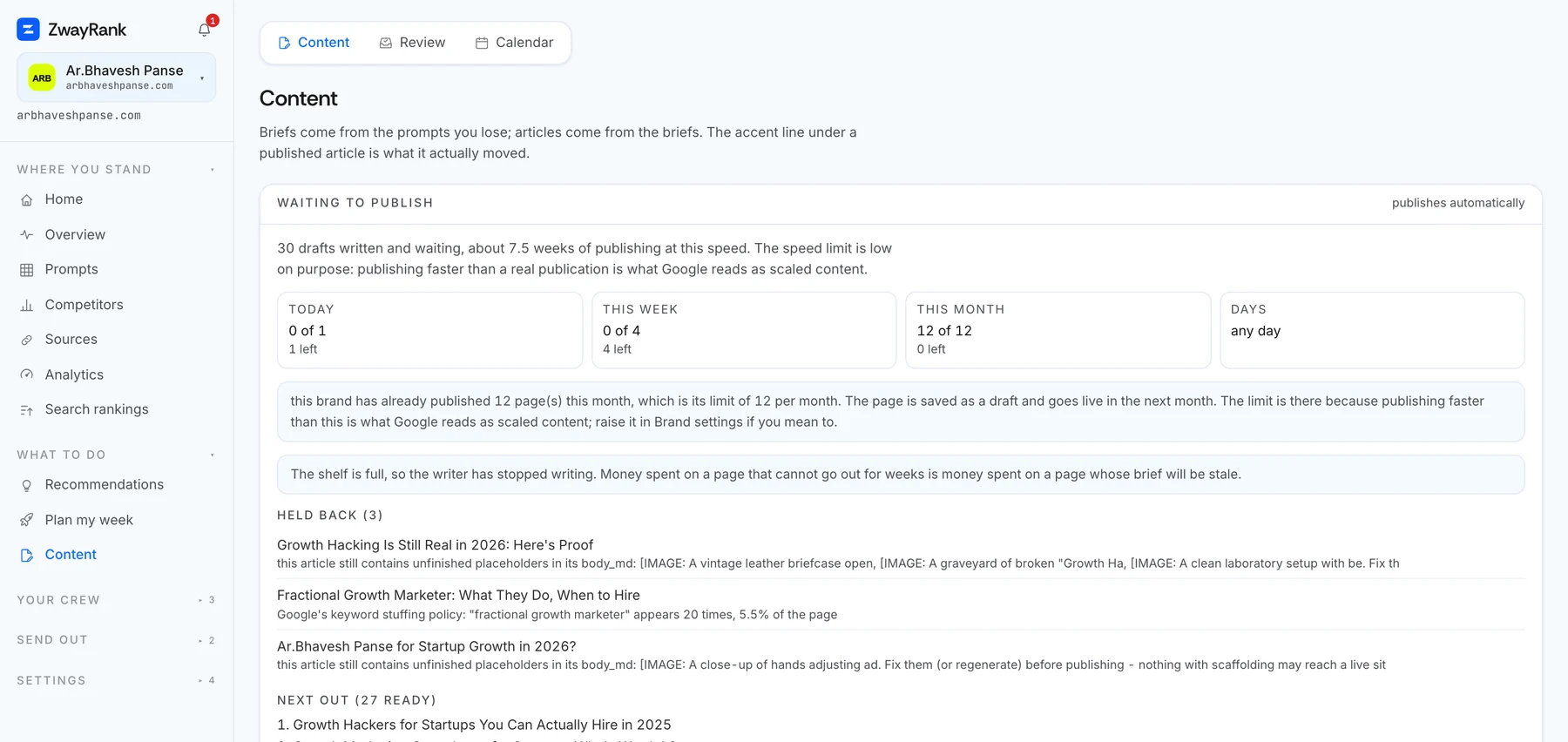
The ZwayRank content screen showing thirty drafts waiting, a monthly publishing limit of twelve pages, and drafts held back because they still contain unfinished placeholders

Thirty finished drafts are waiting here. The product will not publish them all: twelve a month is the limit, because publishing faster than a real publication is what search engines read as spam.

It also holds pages back itself. One is held because an image placeholder was never filled. Another because a phrase repeats too often. The product refuses to damage the customer's site to hit a number.

It publishes into WordPress, Framer, Webflow, Shopify or straight into a code repository.

9 / 18

Twelve agents, one office you can watch.

Customers do not buy an API. They buy a team. So the team is visible: who is working, on what, right now, with every action in a record that has a time and a reason against it.
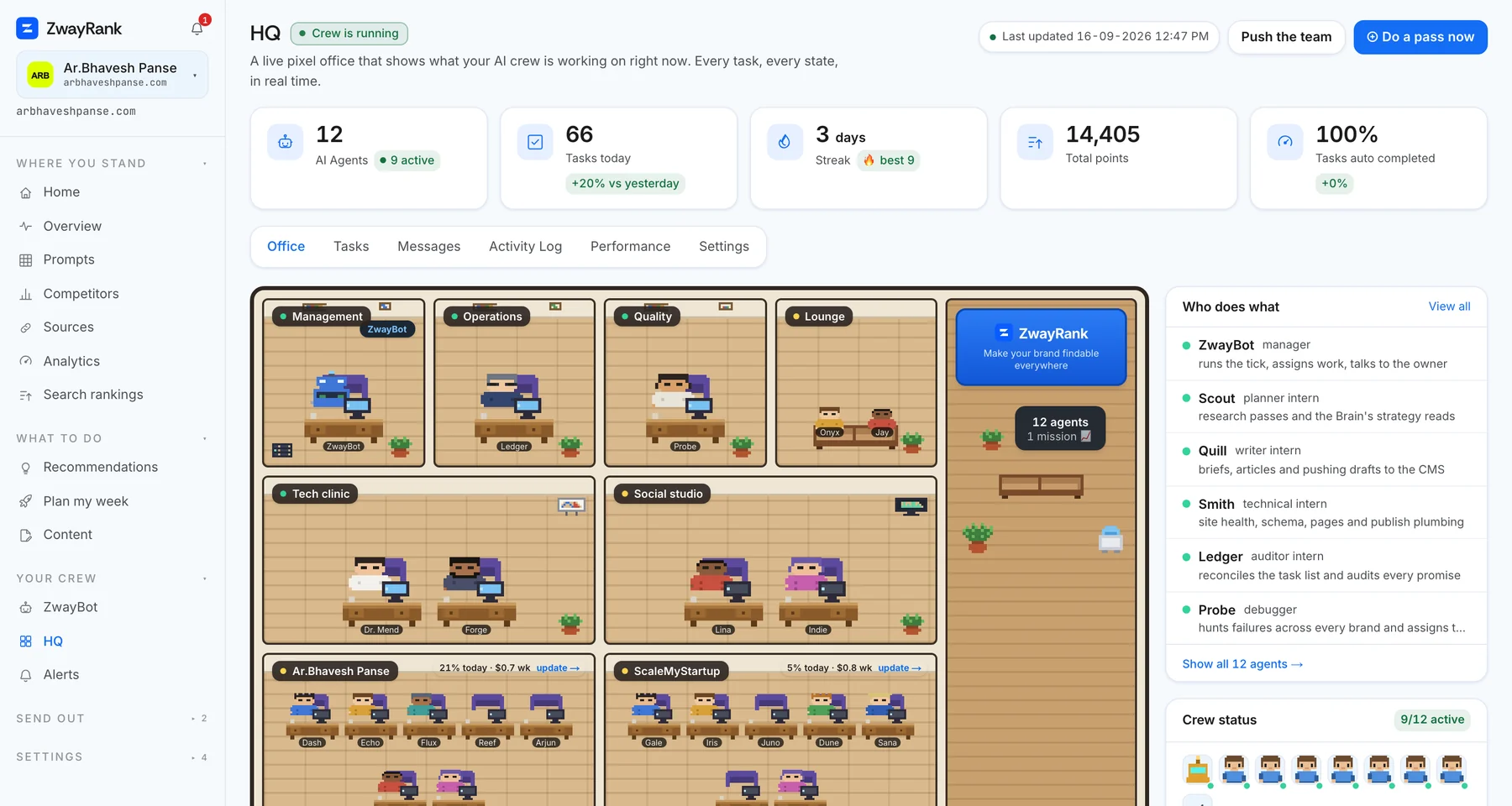
The ZwayRank headquarters screen: twelve AI agents, sixty six tasks today, a live pixel office with named agents at desks and a panel explaining who does what
12agents, 9 working right now
66tasks finished today
100%of those finished without a human
30 minbetween passes, all day, every day
10 / 18

Five businesses pay us. Every one of them upgraded.

We opened it quietly. Every customer bought the one time plan first, used it, and then added the monthly crew. Five out of five. That is the number we watch.

$500monthly recurring revenue
5paying businesses
100%moved from one time to monthly
0churned so far
Running in production4 brands under continuous watch, 125 buyer questions tracked, 2,078 answers read and scored in the last thirty days.
Work deliveredPages written, published and re-checked; site faults found and repaired; backlinks scored; social posts drafted. All of it visible in the record.
Built without fundingOne founder, fourteen months, no sales team, no paid acquisition yet.
11 / 18

Cheap to start, and the model bill is not ours.

Free

One brand

Seven days, first scan on us. No card.

$50 once

Two brands, for life

The door. Every paying customer came through it.

$100 a month

The crew

The twelve agents, working your site all day. This is the revenue line.

$29 a month

Each extra brand

Agencies and studios stack these.

Why the margin holdsCustomers connect their own model keys, so the biggest variable cost sits with them and is visible to them. What we pay for is hosting and data, which is small and flat per customer.
Why the price is low on purpose$100 a month is an amount a founder approves without a meeting. The product we replace costs $2,500 a month and answers email once a week.
12 / 18

A new market on top of an old budget.

Top down

The new line

Getting named by AI assistants is forecast to grow from about $1.09 billion in 2026 to $32.9 billion in 2036, roughly 40% a year. Nobody owns it yet.

Bottom up

The budget it comes from

A small business pays an agency $1,500 to $10,000 a month, or pays $99 to $599 a month for software that only measures. We ask $100 and do the work.

1,000customers on the crew plan is $1.2M a year
10,000customers is $12M a year, before extra brands
$100our price against $2,500 for the human version

Sources: Market Decipher 2026 for market size. Published 2026 pricing guides for agency and software costs.

13 / 18

The trackers cannot become us without becoming an agency.

Trackers

Peec, Profound, Otterly and the rest

Good dashboards. They report where you are named. To do what we do they would have to write, publish and repair customer websites, which is a different company.

Big suites

Semrush, Ahrefs and similar

Enormous data, a bolted on AI panel, and a workflow that still ends with a person doing the task. They sell to teams that already have staff. We sell to founders who do not.

Agencies

People doing it by hand

They do the work, slowly, at twenty five times the price, and they cannot watch every engine every thirty minutes.

What is hard to copyNot the scoring. The doing: publishing safely into somebody else's live website, refusing to publish when the page would hurt them, repairing its own failures, and keeping a record honest enough to show a customer.
What compoundsEvery pass writes to a shared memory the crew reads before it decides. The longer a brand runs, the better the next decision. That history does not transfer to a competitor.
14 / 18

The product is the salesman.

01

Free brand, free first scan

The scan shows a real gap in sixty seconds. That screen sells the rest.

02

We run it on ourselves

Our own website is written and published by the crew. Every page we rank for is a demo.

03

Agencies stack brands

$29 a brand makes us a margin line for a small agency, not a cost.

04

Priced under the meeting

At $100 a month nobody convenes a committee. They just try it.

Next two quartersOpen sign up, a public plan for agencies, the shared work record as a weekly email, and the first paid experiments once a paying customer costs less than three months of revenue to win.
15 / 18

One founder, fourteen months, a product that already runs itself.

Ar.Bhavesh Panse, founder, Zway Studios. Designed and built ZwayRank end to end: the crew, the publishing plumbing into five website platforms, the engine tracking, the billing, the security work.

It was built to run four of his own brands first. Everything in this deck is the product doing that job in public, not a prototype behind a login.

Hiring first with this round: two engineers and one person who talks to customers all day.
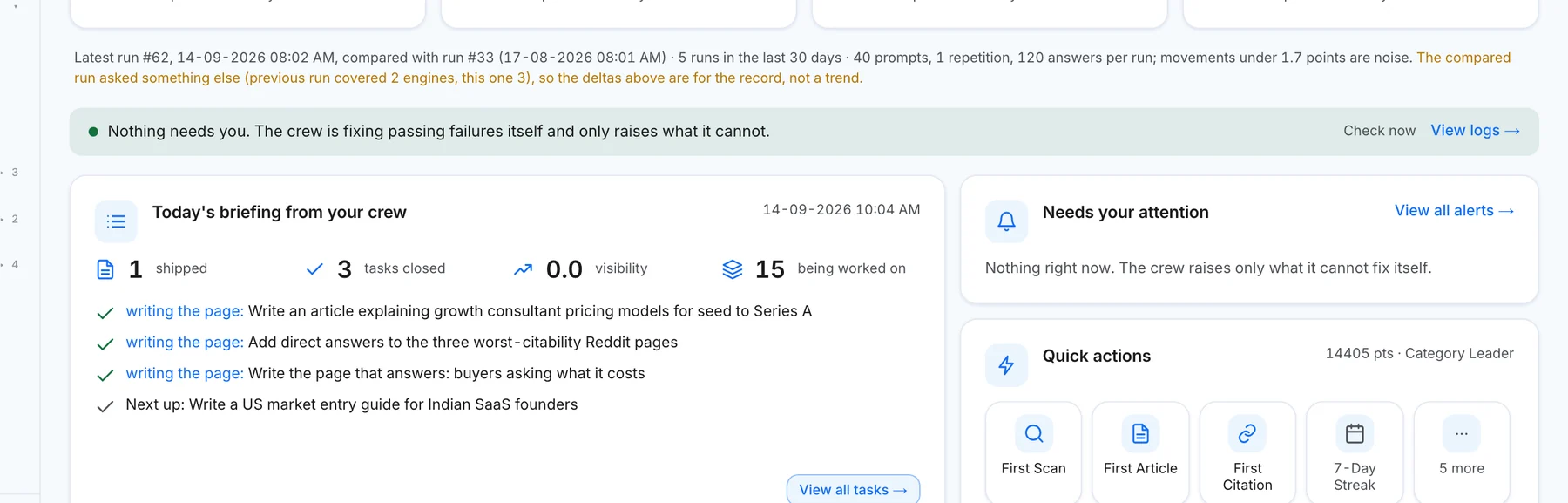
The crew's daily briefing inside ZwayRank: what shipped, what was closed, what is being worked on, and what needs the owner
16 / 18

Raising $400,000 to turn a working product into a company.

The product works and people pay for it. What is missing is hands: nobody is selling, nobody is onboarding, and one person cannot ship and support at the same time.

45%

Two engineers

More website platforms, the agency plan, and the reliability work that a paying base demands.

30%

Getting customers

One person on demos and onboarding, plus the first paid experiments.

25%

Running costs

Hosting, data providers, security review, and the free scans we give away.

18 monthsof runway at the planned spend
1,000paying businesses is the target in that window
$1.2Myearly revenue at that point

Talk to us: hello@zwayrank.com · download this deck · try the product

17 / 18

Appendix: what already works today.

Nothing on this slide is planned. All of it is running in production for four brands right now.

Watching

Three answer engines asked repeatedly, share of voice against named rivals, per engine scores, the sites the answers quote, and real Google rankings on the same questions.

Fixing

Site speed, markup, headings, internal links, broken pages, missing pages, thin pages, and a repair crew that closes its own failures before asking a human.

Publishing

Briefs from the questions you lose, drafts written to a house style, images, and publishing into WordPress, Framer, Webflow, Shopify or a code repository with your approval.

Off site

Backlinks from three separate indexes merged into one list, each link scored for how much it is worth, plus outreach targets taken from the pages the engines already quote.

Reporting

A daily briefing, a weekly email, a downloadable report, an API, and a work record with a timestamp on every action.

Safety

Speed limits so a site is never flooded, approval gates, a full audit trail, per member access by brand, and a daily automated check that customer data is not reachable by anyone else.

18 / 18

Appendix: what could go wrong, and what we do about it.

The engines changeAn assistant could stop linking out, or start selling placement. We track three engines and real search at once, and the work we do, better pages and a healthier site, keeps its value in either world.
A big suite copies itLikely, and slowly. Publishing into a customer's live site is the risky part nobody wants to own. Our head start is in the safety rules, not the scoring.
Quality at scalePublishing to somebody else's site is the thing that can hurt them. The product already refuses to publish unfinished or repetitive pages, and holds a monthly limit. We will keep the limits low.
One founderThe most real risk on this page, and the first thing this round fixes.
Honest about the numbersFive customers and $500 a month is early. Nothing in this deck is annualised or projected except the slide that says it is.